

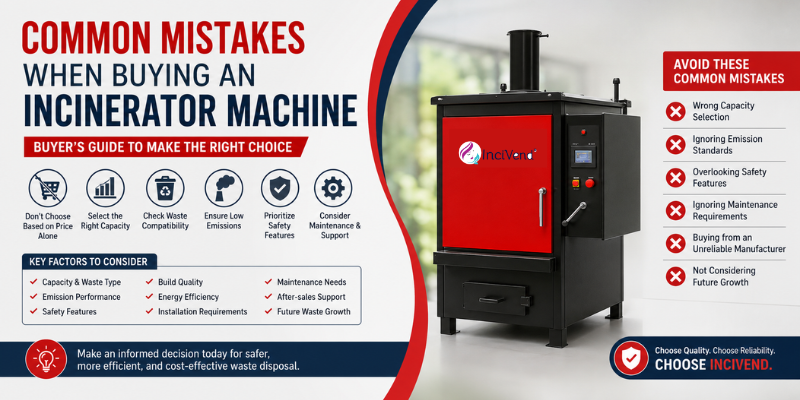
Common Mistakes When Buying an Incinerator Machine
Choosing the right incinerator machine is an important decision for hospitals, schools, colleges, offices, factories, hotels, shopping malls, public washrooms, municipalities, and industrial facilities. The right machine ensures hygienic waste disposal, improves operational efficiency, and supports effective waste management.
However, many buyers make purchasing decisions based only on price or incomplete information. As a result, they often face higher operating costs, reduced efficiency, frequent maintenance, and equipment that fails to meet their actual requirements.
In this guide, you’ll learn the most common mistakes when buying an incinerator machine, practical ways to avoid them, and the key factors to consider before making your investment.
What Is an Incinerator Machine?
An incinerator machine is a waste disposal system that uses controlled high-temperature combustion to reduce waste into ash. As a result, waste volume decreases significantly while hygiene and waste handling improve.
Depending on the application, these machines are commonly used for:
- Sanitary napkins
- Diapers
- Biomedical waste
- Paper waste
- Organic waste
- Institutional waste
- Commercial waste
Why Choosing the Right Incinerator Matters
An incinerator is a long-term investment that directly affects operational efficiency and maintenance costs. Moreover, selecting the right equipment improves hygiene, enhances safety, and delivers dependable performance for years.
The right machine offers:
- Better hygiene
- Efficient waste reduction
- Improved operational safety
- Lower maintenance expenses
- Longer service life
- Better energy efficiency
- Reliable daily operation
Conversely, choosing the wrong machine may result in repeated repairs, increased fuel consumption, and unnecessary operational expenses.
1. Buying an Incinerator Based Only on Price
Price is certainly an important factor. However, it should never be the only reason for selecting an incinerator.
Many low-cost machines compromise on:
- Build quality
- Insulation
- Combustion efficiency
- Safety systems
- Component durability
Although the initial investment may be lower, long-term maintenance and repair costs are often much higher.
Instead, compare overall quality, durability, warranty, and operating efficiency before making a purchase.
2. Choosing the Wrong Capacity
Capacity plays a major role in overall performance.
If the machine is too small, it may:
- Require multiple operating cycles
- Overheat frequently
- Wear out faster
- Increase labor time
On the other hand, an oversized machine may:
- Consume more energy
- Cost more to purchase
- Occupy unnecessary installation space
Therefore, estimate your average daily waste generation before selecting a model.
3. Ignoring Waste Compatibility
Every incinerator is designed for specific waste categories. Therefore, always verify that the machine matches the waste generated at your facility.
Common waste includes:
- Sanitary waste
- Biomedical waste
- Paper products
- Organic waste
- Institutional waste
- Industrial waste
Otherwise, combustion efficiency may decrease while maintenance requirements increase.
4. Not Checking Emission Performance
Modern waste management requires efficient combustion with minimal smoke and odor.
For this reason, always choose an incinerator designed for cleaner combustion and better fuel efficiency.
Ask the manufacturer about:
- Fuel efficiency
- Combustion technology
- Smoke reduction
- Emission performance
5. Overlooking Safety Features
Because incinerators operate at high temperatures, safety should always be a priority.
Look for features such as:
- Automatic temperature control
- Heat-resistant insulation
- Emergency shutdown
- Overheat protection
- Secure loading doors
In addition, durable construction further improves operational safety.
6. Build Quality
Construction quality directly affects performance and longevity.
Ideally, the machine should include:
- Heavy-duty steel construction
- Corrosion-resistant materials
- Premium insulation
- Durable combustion chamber
Consequently, a well-built incinerator generally lasts longer and requires fewer repairs.
7. Forgetting Installation Requirements
Many buyers overlook installation planning.
Before purchasing, confirm:
- Floor space
- Electrical supply
- Ventilation
- Chimney requirements
- Service access
Proper planning helps avoid unexpected installation delays.
8. Operating Costs
The purchase price is only one part of the investment.
Additionally, consider:
- Electricity usage
- Fuel consumption
- Maintenance expenses
- Spare parts
- Cleaning requirements
Over time, an energy-efficient machine can significantly reduce operating costs.
9. Not Checking Maintenance Requirements
Routine maintenance keeps an incinerator operating efficiently.
Therefore, ask about:
- Cleaning schedule
- Spare parts
- Annual servicing
- Warranty
- Technical support
Regular maintenance minimizes downtime and extends equipment life.
10. Buying from an Untrusted Manufacturer
Choosing the right manufacturer is just as important as choosing the machine.
A reliable manufacturer typically provides:
- Product guidance
- Installation support
- User training
- Technical assistance
- Spare parts
- Warranty coverage
- After-sales service
Research the manufacturer’s experience before making a purchase.
11. Ignoring Future Waste Growth
Many organizations expand over time.
Waste generation may increase because of:
- More employees
- Higher patient volume
- Increased student enrollment
- Business expansion
Buying a machine with slightly higher capacity can help avoid early replacement.
12. Not Comparing Different Models
Never purchase the first machine you see.
Compare multiple options based on:
| Feature | Why It Matters |
|---|---|
| Capacity | Matches daily waste generation |
| Build Quality | Longer equipment life |
| Safety Features | Better operator protection |
| Energy Efficiency | Lower operating costs |
| Maintenance | Reduced downtime |
| Warranty | Long-term reliability |
| Manufacturer Support | Faster service and spare parts |
A proper comparison ensures better value for your investment.
Checklist Before Buying an Incinerator Machine
Before finalizing your purchase, ask yourself these questions:
✔ What type of waste will I burn?
✔ How much waste is generated daily?
✔ What capacity do I need?
✔ Is sufficient installation space available?
✔ Does the machine include essential safety features?
✔ Is it energy efficient?
✔ How often does it require maintenance?
✔ Are spare parts easily available?
✔ Does the manufacturer provide after-sales support?
✔ Is warranty included?
Industries That Commonly Use Incinerator Machines
Incinerator machines are widely used across various sectors, including:
- Hospitals
- Clinics
- Schools
- Colleges
- Offices
- Hotels
- Shopping malls
- Factories
- Public washrooms
- Government institutions
- Municipal facilities
- Industrial plants
Each facility should choose a machine that matches its waste volume and operational requirements.
Choose the Right Incinerator Machine
Buying an incinerator machine is a long-term investment that affects operational efficiency, hygiene, maintenance costs, and overall waste management. While the lowest-priced option may seem attractive, it often leads to higher expenses and reduced reliability over time.
By carefully evaluating capacity, waste compatibility, safety features, build quality, energy efficiency, installation requirements, maintenance needs, and manufacturer support, you can choose an incinerator that delivers dependable performance for years to come.
Making an informed decision today helps ensure safer, more efficient, and cost-effective waste disposal in the future.
Frequently Asked Questions
Choose an incinerator machine based on your daily waste volume, waste type, available installation space, energy source, safety features, and maintenance requirements. Buying a machine that matches your operational needs improves efficiency, reduces operating costs, and extends the equipment’s lifespan.
The biggest mistake is focusing only on the purchase price. A low-cost incinerator may have lower build quality, higher maintenance costs, and shorter service life. It’s better to consider performance, durability, safety, and long-term operating costs before making a decision.
Incinerator machines are commonly used in hospitals, clinics, schools, colleges, hotels, factories, offices, shopping malls, public washrooms, municipalities, and industrial facilities. They help manage approved waste efficiently while maintaining hygiene and supporting proper waste disposal practices.
Choosing the correct capacity ensures the machine can handle your daily waste without overloading or wasting energy. An undersized incinerator may require frequent operation, while an oversized model can increase installation and operating costs unnecessarily.
A quality incinerator machine should include a durable combustion chamber, efficient insulation, temperature control, low-emission combustion, user-friendly operation, strong safety features, and dependable after-sales support. These features improve performance, safety, and long-term reliability.
Incivend offers high-quality incinerator machines designed for efficient waste disposal, reliable performance, and long-term durability. With a focus on quality manufacturing, safety, and customer support, Incivend provides solutions suitable for institutions, commercial facilities, healthcare organizations, and industrial applications looking for dependable waste management equipment.
Ready to Choose the Right Incinerator Machine?
Avoid costly buying mistakes with expert guidance from Incivend. Explore our reliable, high-performance incinerator machines designed for safe, efficient, and long-lasting waste management.
Contact Incivend today to find the ideal incinerator solution for your facility.


